
Japanese kitchen knives are famous for their sharpness, thin blades and craftsmanship. But the first thing that confuses new buyers is the names: gyuto, santoku, nakiri, yanagiba, deba. Each is designed for a specific job, and some are better for home cooks than others. This guide explains the main Japanese kitchen knife types, what each one does and which you actually need.
If you already know which type you want and are looking for specific recommendations, see our guide to the best Japanese chef knives.
Single Bevel vs Double Bevel
Before looking at the types, it helps to understand one key difference. Traditional Japanese knives are often single bevel: sharpened on one side only, with the other side flat or slightly hollow. This produces an extremely fine edge for precise cuts, especially for fish and vegetables, but it takes practice and knives are made for right- or left-handed users. Most Western-style Japanese knives, and those designed for home cooks, are double bevel, sharpened on both sides like a European knife.
All-Purpose Knives
Gyuto (牛刀)
The name means “beef sword”, but the gyuto is the Japanese version of the Western chef’s knife. It has a pointed tip and a gently curved edge that allows a rocking motion as well as push cuts. Blades usually range from about 180 mm to 270 mm, with 210 mm and 240 mm the most popular sizes. Compared with a German chef’s knife, a gyuto is lighter, thinner and usually harder, so it holds a sharper edge. If you buy only one Japanese knife, this is the most versatile choice.
Santoku (三徳)
Santoku means “three virtues”, usually explained as meat, fish and vegetables, or slicing, dicing and mincing. It was developed in Japan in the twentieth century as a home cook’s all-rounder. The blade is shorter than a gyuto, typically 165 to 180 mm, with a flatter edge and a rounded “sheep’s foot” tip. It suits push cutting and chopping rather than rocking, and its compact size makes it popular in smaller kitchens.
Bunka (文化)
The bunka is a close relative of the santoku with an angular, reverse-tanto tip, sometimes called a K-tip. The sharp point is handy for detailed work such as scoring or fine cuts. It is a stylish alternative to the santoku for the same tasks.
Vegetable Knives
Nakiri (菜切り)
The nakiri is a rectangular vegetable knife with a straight edge and a square tip. The flat edge meets the cutting board along its whole length, so it cuts cleanly through vegetables without leaving connected slices. Nakiri are double bevel and usually around 165 mm long. They are excellent for home cooks who prepare a lot of vegetables, but they are not designed for meat with bones or for tip work.
Usuba (薄刃)
The usuba is the professional, single-bevel version of the vegetable knife. Its very thin blade is used by chefs for precise techniques such as katsuramuki, peeling a daikon radish into a long, paper-thin sheet. It demands skill and careful sharpening, so it is rarely the best choice for home kitchens.
Fish and Meat Knives
Yanagiba (柳刃)
The “willow blade” is the classic sashimi knife. It is long, typically 240 to 300 mm, narrow and single bevel. The length lets the chef slice raw fish in one long pulling stroke, which keeps the surface smooth and glossy instead of torn. A regional variant from the Kanto area, the takohiki, has a square tip.
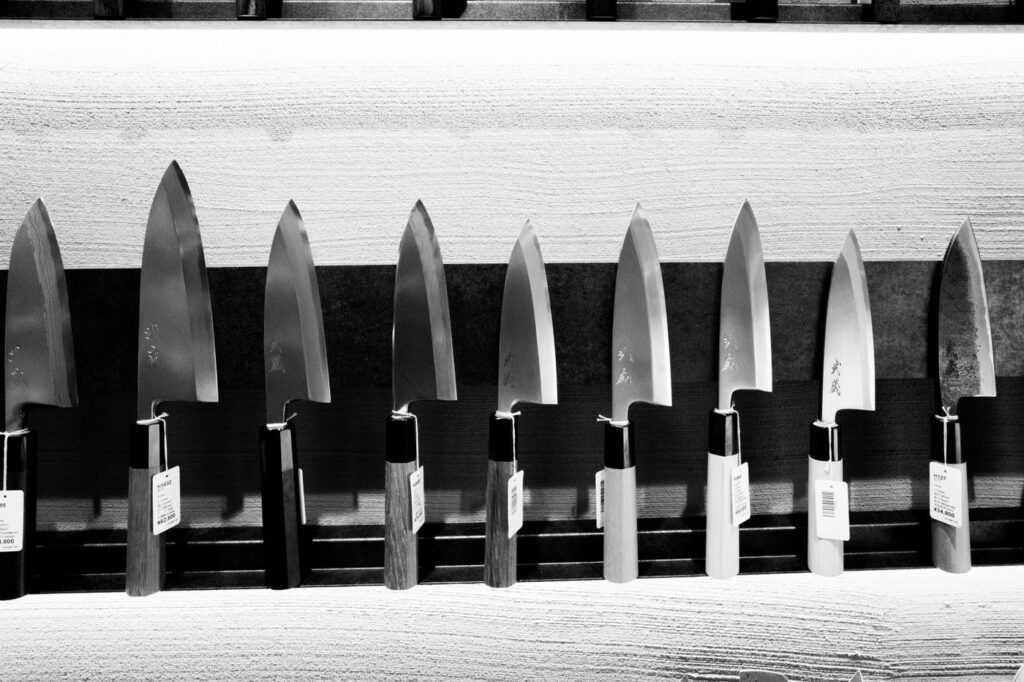
Deba (出刃)
The deba is a thick, heavy, single-bevel knife for breaking down whole fish: cutting through heads, removing fillets and working around small bones. Its weight does much of the work. It is not meant for chopping through large bones or frozen food, which can chip even a thick blade.
Sujihiki (筋引)
The sujihiki is a long, thin, double-bevel slicing knife, similar to a Western carving knife. It is used for slicing cooked meat, roasts and large fish fillets, and is an easier alternative to the yanagiba for home cooks.
Honesuki (骨スキ)
A small, stiff boning knife with a triangular blade, used mainly for breaking down poultry. The pointed tip works around joints to separate them cleanly.
Small Knives
Petty Knife (ペティナイフ)
The petty knife is the Japanese utility or paring knife, usually 120 to 150 mm long. It handles peeling, trimming, small fruit and herbs, and complements a gyuto or santoku perfectly.
Specialist Knives
- Kiritsuke (切付): a long blade with an angled tip, traditionally a single-bevel knife associated with head chefs. Double-bevel versions are sold as multi-purpose knives.
- Soba kiri and menkiri: heavy, rectangular knives for cutting fresh noodles into even strands.
- Unagi-saki: knives shaped specifically for filleting eel, with regional styles from Tokyo, Osaka and Kyoto.
Steel and Care
Japanese knives are made from either carbon steel or stainless steel. Carbon steels, such as the white (shirogami) and blue (aogami) steels produced in Japan, take a very sharp edge and are easy to sharpen, but they rust if left wet and develop a patina over time. Stainless steels, such as VG-10 and powdered steels like SG2, resist rust and need less attention. Many knives combine a hard core with softer outer layers, sometimes with a decorative Damascus pattern.
Because Japanese blades are hard and thin, they need gentle handling:
- Use a wooden or soft synthetic cutting board, never glass or stone.
- Wash by hand and dry immediately; never put them in the dishwasher.
- Avoid twisting the blade, cutting bones or frozen food.
- Sharpen on whetstones rather than pull-through sharpeners, which can damage thin edges.
Which Japanese Knife Should You Buy First?
- One knife for everything: a gyuto of 210 mm, or a santoku if you prefer a shorter blade.
- A second knife: a petty knife for small tasks.
- If you cook mostly vegetables: add a nakiri.
- If you prepare sashimi or whole fish: a yanagiba and a deba, once you are comfortable with single-bevel knives.
Conclusion
Each Japanese kitchen knife type was designed to do one job extremely well. For most home cooks, a gyuto or santoku plus a petty knife covers almost everything, with a nakiri as a pleasant addition. Specialist blades such as the yanagiba, deba and usuba reward practice and are best added once you know you will use them.