
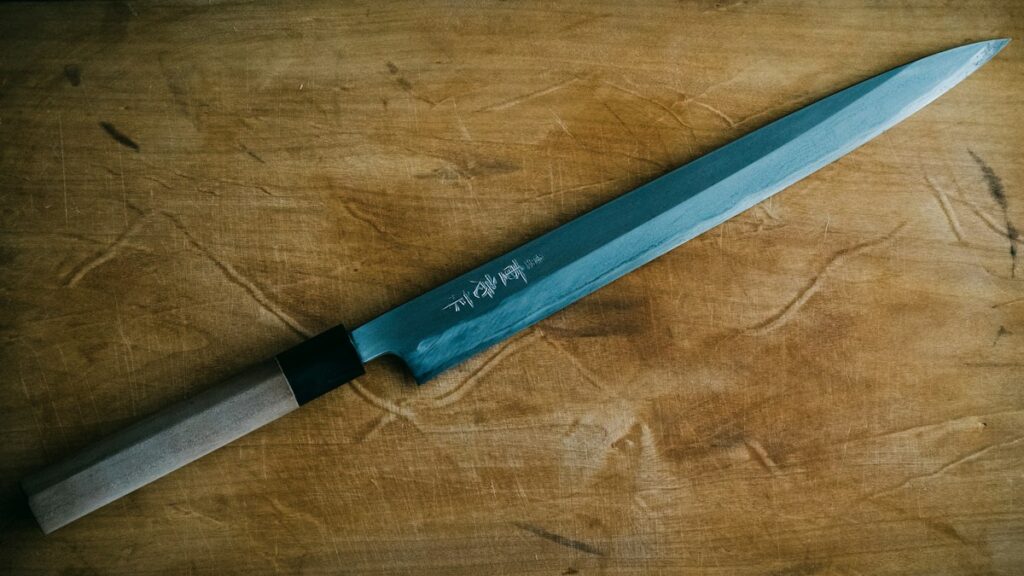
There’s a particular sound in a good sushi kitchen just before service — not the hum of a refrigerator or the clatter of prep, but something quieter. A single stroke of steel against stone, repeated, unhurried, almost meditative. If you looked over the chef’s shoulder, you’d notice something strange about the knife in his hands. One side of the blade is polished into a long, curved bevel. The other side is almost flat — a shallow, deliberate hollow, like a thumbprint pressed into the steel and left there. To anyone used to a Western kitchen knife, it looks unfinished. Lopsided. Possibly even a mistake.
It is not a mistake. It’s one of the oldest, most quietly demanding ideas in Japanese craft, and once you understand what it’s actually doing, you start noticing it everywhere — in tea bowls, in carpentry joints, in the way a calligrapher holds a brush. The idea that a tool asking more of you might, in the end, be giving you more back.
A Blade With Only One Side
This is a single bevel knife — kataba, in Japanese, meaning literally “one edge.” Almost every knife sold outside Japan, including most Japanese knives made for export, is double bevel: both sides of the edge ground at a matching angle, symmetrical, forgiving, equally at home in a right or left hand. It’s a sensible design, and there is nothing wrong with it. If you want the full map of the shapes and their names, our guide to Japanese kitchen knife types covers them one by one.
A single bevel knife refuses that symmetry on purpose. Only one face carries the cutting angle. The other stays nearly flat, with a shallow concave hollow called the ura — “the reverse side” — that keeps the blade from clinging to whatever it’s just cut. Because only one face is doing the work of separating the material, that single face can be ground thinner and sharper than a double bevel edge could ever manage without becoming fragile. The tradeoff is that the knife is handed, built specifically for a right- or left-handed user, and that sharpening it correctly means matching an angle by feel rather than letting the blade mirror itself automatically. There is no shortcut version of this skill. You either learn to read the stone, or the edge slowly drifts wrong.
It is, in other words, a tool that punishes carelessness and rewards attention — which turns out to be the whole point.
Three Blades, Three Kinds of Precision
Walk through a professional Japanese kitchen and you’ll find the single bevel tradition living in three distinct shapes, each built around a single, uncompromising task.
Yanagiba
The yanagiba — “willow blade,” named for its long, slender profile — exists for one motion: slicing raw fish in a single unbroken draw. No sawing back and forth, no sideways pressure. Sashimi cut this way keeps its cell structure intact; the same fish cut with a sawing motion turns slightly mealy, the difference detectable on the tongue even if you couldn’t say why. A yanagiba doesn’t make a chef better at this motion. It makes the motion possible in the first place.
Deba
The deba takes on the opposite end of the process — breaking a whole fish down into something usable. Its single bevel edge and thicker spine let a trained hand separate flesh from bone along one continuous line, rather than working through it in pieces. Watch it done well and it looks less like cutting than like following a seam that was somehow already there.
Usuba
And the usuba, the vegetable specialist, is the blade behind katsuramuki — the impossibly thin, continuous vegetable peel that unspools like ribbon in high-end kaiseki presentation. A skilled cook with a double bevel knife can get close to this. A trained hand with a usuba does it as though the vegetable were offering no resistance at all.
Why Not Simply Use What’s Easier?
This is the fair question, and the honest answer is: for daily cooking, you probably should. Double bevel knives are more forgiving to sharpen, work in either hand without adjustment, and handle the mixed, unpredictable cutting that a real kitchen demands hour to hour. Nobody is arguing that a home cook needs a yanagiba to make dinner.
But the persistence of single bevel knives, more than a century after mass production made symmetrical grinding the easy global default, points at something particular about how Japanese craft tends to think about difficulty. There’s a thread running from the sushi counter through the tea ceremony to the carpenter’s chisel: the belief that a tool which demands real attention from its user is not an inconvenience to be engineered away, but part of what makes the result worth having. Ease and mastery are treated as somewhat separate goals. You can chase either one. They don’t always point the same direction.
This isn’t nostalgia, and it isn’t inefficiency for its own sake. Most professional kitchens in Japan use double bevel knives for the bulk of their work and reach for single bevel blades only when the task specifically calls for what they offer. It’s less a rejection of convenience than a refusal to let convenience quietly become the only value that matters.
If You’re Curious Enough to Try
A single bevel knife is not where a beginner should start — the learning curve on sharpening alone is steep enough to discourage most people before they’ve made a single satisfying cut. But if you already have some comfort with a whetstone, and you’re curious what it actually feels like to use a blade built around a single, deliberate compromise, it’s worth reading further before buying one. Understanding a single bevel Japanese knife in more depth — the structural logic, the sharpening angle, which of the three shapes actually fits how you cook — tends to matter more than the knife itself once you own one.
The steel isn’t really the point. It rarely is, in Japanese craft. The point is what the object quietly asks of the person holding it, and whether you’re willing to answer.